Share
Hungarian unions demand heat limits as heatwave bites factories
2026. 08. 12.
5 min
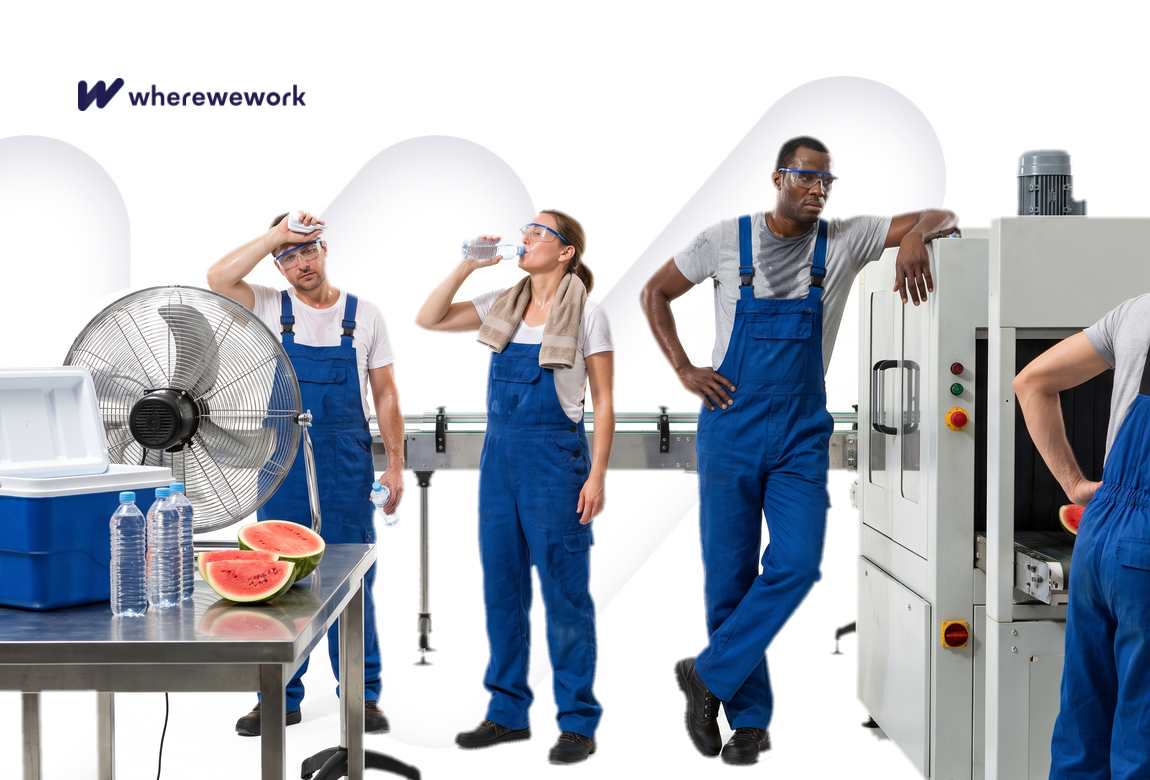
Alcohol-free beer, free watermelon, ten minutes of air-conditioning per hour. That is the current shape of heat protection on many Hungarian production lines this August, while colleagues in the office building next door are told to work from home. The gap between those two experiences is now the centre of a formal union push to rewrite the country’s workplace-heat rules.
The Hungarian Trade Union Confederation, MASZSZ, is demanding a statutory workplace temperature limit and an immediate modernisation of occupational safety rules. According to reporting by Pénzcentrum, MASZSZ president Róbert Zlati says decision-makers have shown no willingness to change the workplace-heat rules despite repeated warnings, and the confederation is now running an online petition to protect workers’ health and wages during heatwaves.
The core complaint is simple: the current Hungarian regulation, which prescribes five to ten minutes of rest per hour in hot conditions, was written before weeks-long extreme heat became a recurring feature of the Hungarian summer. It was designed for a heatwave that lasted days, not the compounding exposures workers now face across an entire shift pattern.
For employees: what MASZSZ is actually demanding
If you work in a heat-exposed role, the union’s asks are worth knowing in detail, because they define what “adequate” protection could look like if the rules are updated. MASZSZ wants a new heat protocol that sets a clear temperature threshold at which work must be periodically restricted or fully stopped, indoors and outdoors. The confederation is also demanding that workers be able to continuously and transparently monitor the current temperature measured at their own workplace, not just trust that someone else is watching the thermometer.
The wage protection point is arguably the most consequential. MASZSZ wants a legal guarantee that employers cannot deduct forced heat-related rest periods from workers’ pay. In practice, that means if the mercury forces you off the line, your wages should not follow you off the line. Without that clause, any new rest rule risks becoming a de facto pay cut.
What factory floors actually look like right now
Pénzcentrum, citing original reporting from Népszava, describes the makeshift accommodations in place across Hungarian plants during the August 2026 heatwave. Some factories give outdoor workers alcohol-free beer, free watermelon or ice cream. At one plant, workers may spend ten minutes per hour in an air-conditioned room, with industrial fans running on the production line the rest of the time. Some employers have temporarily stopped cooking hot meals so the kitchen would not add heat to the building, providing cold food instead. A few sites keep dedicated buses on standby to send workers home immediately if conditions become unbearable.
Union feedback highlights an obvious flaw in the AC-room approach: even when firms provide air-conditioned rest rooms, workers often cannot reach them within the short break because the rooms are located too far from the work area. A ten-minute cooldown that takes six minutes to walk to is not a ten-minute cooldown.
There is also a production-pressure layer to this. Pénzcentrum reports that production targets have not been lowered despite the heat, and that some middle managers exert excessive pressure on workers to meet goals. That is where informal heat perks stop being enough: no amount of free ice cream compensates for an unchanged quota in 38°C on the line.
The class divide: home office vs the shop floor
The Hungarian government has asked firms that can to order remote work during extreme heat, and the Ministry of Education and Child Affairs has recommended that nurseries and kindergartens consider closing during heat alerts. Government has also recommended home office work for the public sector on energy-security grounds during the heatwave.
The unspoken problem: home office is only an option for people whose jobs run on a laptop. Automotive suppliers and continuous-production plants cannot meaningfully cut energy use because the technology does not allow reduced-mode operation. You cannot send a stamping press home. The result is a heat-safety access gap that maps almost perfectly onto white-collar versus blue-collar work.
HVG points out a domestic dimension that makes the workplace question sharper: according to KSH data, 5.8% of Hungarians in 2024 lived in conditions where they could not adequately heat their home in winter. The KSH’s official deprivation measure lists 13 basic-need items but does not yet include inability to cool the home in summer, even though for many workers the workplace is the only air-conditioned space they have access to. Summer cooling poverty now reaches into middle-class households too. If your factory pulls its AC to hit a 10–15% energy-savings target, you may be walking from an overheated line into an overheated flat.
Practical steps if you work in a heat-exposed role
- Ask your employer, in writing, what the current heat protocol at your site is: temperature thresholds, rest cycles, distance to the cooled room, and whether rest counts as paid working time.
- Check your collective agreement (if one applies at your workplace) for any clause that already sets heat-related work restrictions or additional rest above the statutory five to ten minutes per hour.
- If production targets have not been adjusted for the heat, raise it with your line manager and your union representative together, not separately. This is the pattern MASZSZ is challenging at the national level.
- Watch for burnout signs in yourself and colleagues: heat exhaustion compounds fast when quotas do not move, and it is often mistaken for “just being tired”.
Employer reviews from workers in the same sector can also tell you a lot about how a company handles seasonal extremes before you accept a role there. How a plant treats its outdoor and line workers during a heatwave is one of the clearest signals of its underlying workplace culture.
For HR: what the coming rule change may require
If you sit on the HR or operations side, this dispute is not an abstract union story. It is a preview of what your compliance stack will need to handle if MASZSZ wins even a fraction of its demands. A statutory temperature limit implies real-time measurement, logged records, and enforceable stop-work triggers, all of which need process owners inside HR and EHS before they need capital investment in cooling.
The energy dimension matters here too. Pénzcentrum quotes Pulger Veronika, an energiagazdálkodási specialista (energy management specialist), on how firms should think about scenario planning:
“a cégeknek megfontolandó lehetőség lenne tehát előre felkészülniük a tartós hőhullámokra, és átgondolva, mérlegelve dönteniük arról, hogy hőségria dó idején otthoni munkavégzést vagy irodai jelenlétet rendelnek-e el”
In short: companies should prepare in advance for prolonged heatwaves and decide deliberately whether to order home-office work or on-site presence during a heat alert. The point is that this becomes an HR decision made in cold blood in April, not a scramble in August.
Three questions worth stress-testing your own operation against:
- Wage treatment of forced rest. If new rules require paid stop-work above a threshold, is that already reflected in your labour cost modelling and your collective agreement, or would it land as a surprise line item?
- Geometry of cooled space. Union feedback is unambiguous that AC rooms placed too far from the line do not function as rest infrastructure. This is a plant-layout question, not a facilities-budget question.
- Production targets in heat mode. If quotas remain static during a red heat alert, middle managers will absorb the pressure and pass it down. That is where the reputational risk lives, both in employer branding and in employer reviews written by your own workforce after the season.
The bigger signal
Whether or not MASZSZ’s petition converts into a legislative change this year, the direction of travel is clear. Occupational safety rules written for a milder climate are being asked to carry a workload they were not designed for, and the makeshift bridge, watermelon, industrial fans, ten-minute AC breaks, is visibly straining. Employers who are still treating heat protection as a summer improvisation will find themselves out of step with both regulators and their own workers, faster than they expect.
Share
What I read is worth it:
Read all the articles about
Ethics Career planning Employee experience Editorial Balance About the crafts LegislativeArticle written by:
 wherewework.hu
Comments
0 comments
No comments! Be the first to comment on this article!

Access your account and add your comment
Ethics


Subscribe to the Newsletter
Read articles of interest from wherewework.hu contributors
