Share
Gender Gap Report 2026: even Europe's most equal countries fall short
2026. 10. 13.
3 min
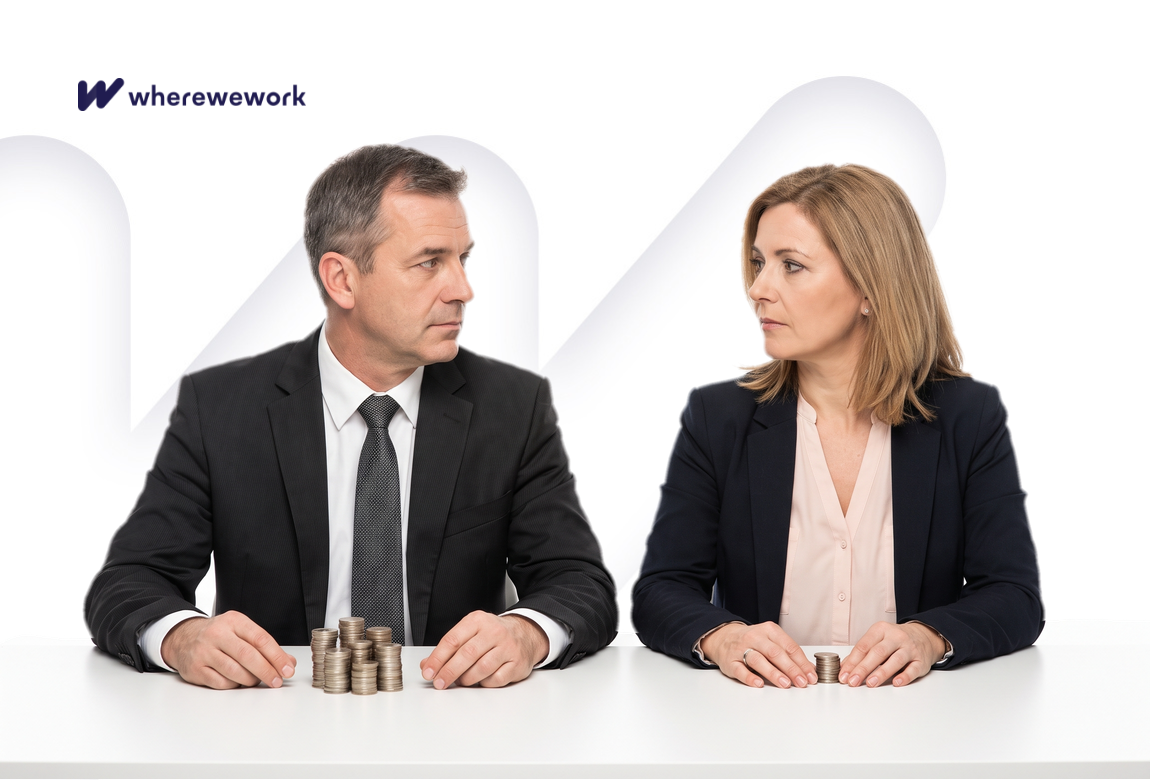
Iceland has topped the World Economic Forum’s Global Gender Gap Report again, with a score of 93%. It is the only country above 90%. Even so, women in Iceland earn only about two-thirds of what men earn, by the report’s estimate. If the world’s most equal labour market still has a pay gap that size, high scores on education and political participation clearly don’t lead to equal pay on their own.
For HR leaders in Hungary, this report matters. Hungary scores 70.7% and ranks 85th of the 145 countries assessed. Most of the countries competing with you for skilled workers in Europe rank well above that.
What the 2026 report measures
The WEF compares 145 countries in four areas: economic participation and opportunity, educational attainment, health and survival, and political empowerment. Europe has the highest regional score, at 75.7%, and seven of the world’s top ten countries are European. At the current pace, though, Europe still needs about 70 more years to reach full parity.
The overall rankings show how wide the spread is inside Europe. Iceland leads with 93%, Finland follows with 87.2%, the UK places 5th with 84.2% and Germany 9th with 81.7%. Hungary’s 70.7% puts it in a different group.
The economic gap is the weakest area, even at the top
In nearly every top-ranked country, the economic score is the one that pulls the total down. Iceland’s economic opportunity score is 81.6%, far below its overall 93%. In the UK, women’s estimated earned income is 68.5% of men’s, even though the country ranks in the global top five.
Several Nordic countries are going backwards. Finland slipped because its economic indicators weakened, and women’s labour participation there hasn’t returned to its pre-pandemic level relative to men’s. Norway’s economic score has fallen from a 2015 peak of 86.8% to 76.9%. Denmark, at 81% and 11th place, saw its economic score worsen slightly, and women hold about 32% of senior roles there.
Germany shows the gap most clearly. It is 9th overall but only 80th on economic opportunity, and women hold just over 30% of senior roles. Spain, 12th with 79.6%, has an economic score of 73.1%, and women’s labour participation there is 9.2 points below men’s.
Where progress has happened, and why it is slow
Sweden has Europe’s highest score for economic participation and opportunity, at 82.4%, and women hold close to 44.5% of senior roles. But its overall score has risen by only one point since 2006. Ireland has made the steepest climb of the group: its economic score went from 64% in 2006 to 76.1%. Lithuania rose five places to 14th with 79.1%, but its economic score fell.
Across these countries, a better overall ranking doesn’t mean the economic gap is shrinking. National policy can open up access to education, healthcare and politics. Who gets paid what, and who gets promoted, is still decided by employers in their pay and promotion processes.
What this means for HR teams in Hungary
If your organisation hires in the same talent pool as Austrian, German or Nordic employers, Hungary’s 85th place is a business risk as well as a reputation issue. Women who look at offers across borders can compare how employers treat them on pay, not only how much they pay. Retention pressure tends to be highest among mid-career women, because the earnings gap widens around promotion decisions.
The report also undermines a common assumption: that an equally educated pipeline will close the gap over time. Iceland’s and the UK’s earned-income figures show that it doesn’t. Organisations that make progress tend to treat pay equity as a process they control and measure, not something that will fix itself.
Practical steps to consider
- Run a pay gap audit by role and level, not only a company-wide average. Gaps often appear at promotion points and in variable pay.
- Set clear salary ranges for each role, so offers depend less on individual salary negotiation, which tends to widen gaps.
- Track the promotion pipeline by gender, especially the move into senior roles, where even Germany and Denmark stay around a third women.
- Compare your pay with market data for the same roles across your competitor set, including employers outside Hungary.
- Listen to employee feedback: employer reviews often reveal perceived unfairness before it shows up in exit interviews.
The takeaway
The 2026 report’s main lesson for employers is that equal education doesn’t produce equal pay. At current rates Europe is roughly 70 years from parity, and the economic gap is the one employers can most directly close. The organisations that close it first will have an advantage in retaining women, and that advantage will show up in their pay data and in what their employees say about them.
Share
What I read is worth it:
Article written by:
 wherewework.hu
Comments
0 comments
No comments! Be the first to comment on this article!

Access your account and add your comment
Editorial

Subscribe to the Newsletter
Read articles of interest from wherewework.hu contributors
