Share
Minimum Wage in Hungary in 2025: Current Level, Recent Evolution and Outlook
2025. 11. 28.
3 min
Hungary’s minimum wage system is built around two statutory levels: a general minimum wage and a higher guaranteed minimum wage for skilled workers. This dual structure is a defining element of the Hungarian labour market and influences wage-setting, competitiveness and social protection across the entire economy. In 2025, Hungary enters the first year of a three-year agreement that foresees continuous increases, aiming to improve living standards while providing predictability for employers and employees alike.
1. What is the minimum wage in 2025 and to whom it applies
Beginning 1 January 2025, Hungary’s minimum wages are set at two levels. The general minimum wage is 290,800 HUF per month, approximately €710–€720, and applies to full-time workers in positions that do not require formal vocational qualifications. The guaranteed minimum wage for skilled workers is 348,800 HUF per month, equal to roughly €850–€870, and applies to jobs requiring certified skills or vocational education.
Both levels are legally binding for full-time employment, and wages for part-time employees must be scaled proportionally. The 2025 update represents a significant increase compared to the previous year, with a rise of about 9% for the general minimum wage and roughly 7% for the guaranteed minimum wage.
2. How the minimum wage evolved in recent years (2022–2025)
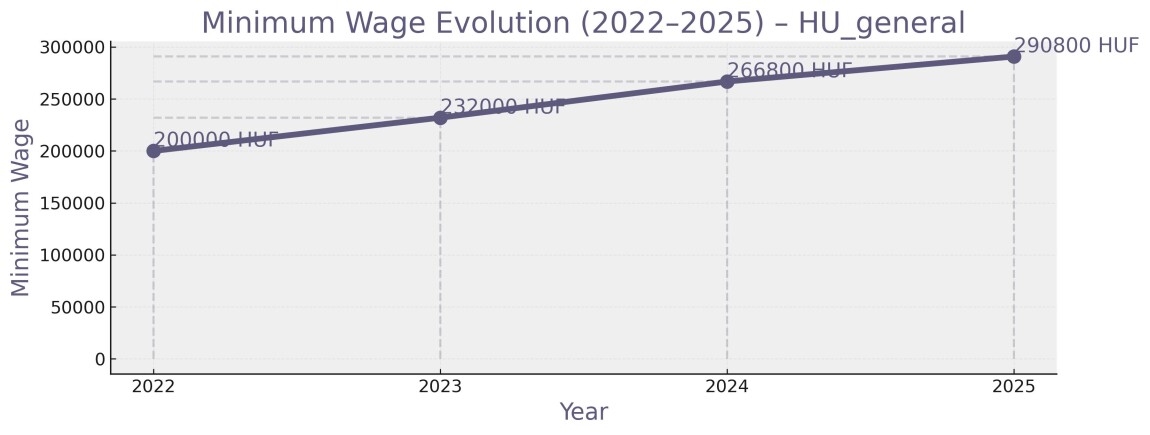
Hungary has seen rapid and consistent growth in minimum wages over the last few years. In 2022, the general minimum wage was 200,000 HUF. It increased to 232,000 HUF in 2023 and then to 266,800 HUF in 2024. The guaranteed minimum wage followed the same upward trend, rising from 260,000 HUF in 2022 to 296,400 HUF in 2023 and to 326,000 HUF in 2024.
The move to 290,800 HUF and 348,800 HUF in 2025 marks the start of a broader three-year agreement designed to bring the minimum wage closer to 50% of the national average gross wage by 2027. This structure provides a stable trajectory for wage development and contributes to long-term economic planning.
3. What the 2025 minimum wage means in practice
In practical terms, the 2025 minimum wage levels have a clear impact on workers’ take-home pay and on employers’ labour costs. An employee earning the general minimum wage of 290,800 HUF (around €710–€720) receives an estimated net salary of roughly 193,000–195,000 HUF per month, depending on tax circumstances. A skilled worker earning the guaranteed minimum wage of 348,800 HUF (approximately €850–€870) receives a net salary in the range of 230,000–235,000 HUF.
For employees, the 2025 increases offer improved income security and partial compensation for recent inflation. For employers, particularly in sectors such as retail, hospitality or light manufacturing, the updated wage thresholds increase payroll costs and may require adjustments to operational or pricing strategies. In higher-value sectors, competition for skilled workers already keeps wages well above the statutory minimums.
4. The regulatory context and the three-year agreement
Hungary sets its minimum wage levels through national consultations between the government, employer associations and trade unions. After negotiations, the government issues a formal decree establishing the new amounts. The 2025 update is part of a three-year agreement introduced at the end of 2024, with planned further increases in 2026 and 2027.
The goal of this multi-year approach is to ensure predictability, gradually increase the wage floor and bring the minimum wage closer to half of the national average wage. This aligns with European discussions on adequate minimum wages and reflects Hungary’s intention to secure a stable and competitive labour market.
5. Sector-specific considerations
Hungary does not use separate sectoral minimum wages; instead, it relies on the two nationwide statutory levels. The guaranteed minimum wage already creates differentiation between skilled and unskilled roles. In high-demand sectors such as automotive, IT or business services, wages often exceed these thresholds due to labour shortages and market competition. In lower-wage sectors, however, the statutory minimums remain the dominant reference point and strongly influence compensation structures.
Conclusions
Hungary’s 2025 minimum wage levels — 290,800 HUF for the general minimum wage and 348,800 HUF for the guaranteed minimum wage — represent a meaningful increase and form part of a wider multi-year plan to strengthen the country’s income floor. These adjustments provide workers with greater financial stability while posing additional cost challenges for employers. The structured, predictable framework now in place brings clarity to wage developments up to 2027, supporting better planning for both employees and businesses as Hungary continues to navigate economic pressures and labour-market competitiveness.
Share
What I read is worth it:
Article written by:
 wherewework.hu
Comments
0 comments
No comments! Be the first to comment on this article!

Access your account and add your comment
HR Metrics


Subscribe to the Newsletter
Read articles of interest from wherewework.hu contributors
